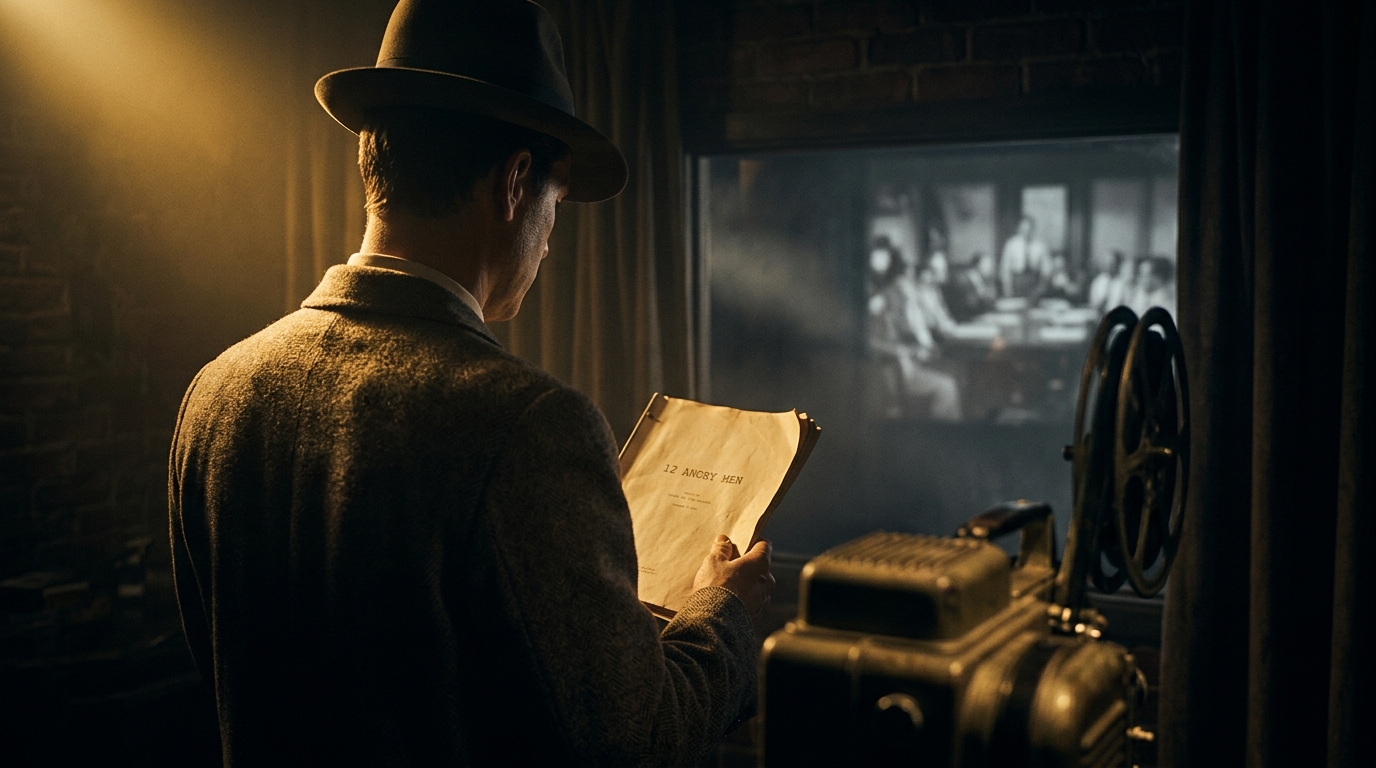
Consider the following profile of a film: black and white, released in 1957, set entirely in a single room, no romantic subplot, no special effects, no action sequences, budget of $397,751, box office of $4.36 million.
By every commercial and demographic predictor in our model, this film should be obscure. Instead, 12 Angry Men has 974,234 IMDb votes, a 9.0 average rating, a perfect 100% on Rotten Tomatoes, and a master score of 95.1 — the fourth-highest in our entire 20,000-film database.
Nearly a million people — most born decades after the film’s release — have watched a 68-year-old black-and-white film about twelve men arguing in a room and felt compelled to rate it a 9 out of 10. This is not supposed to happen.
The Structural Perfection
When we run 12 Angry Men through our 20-feature screenplay analysis pipeline, it produces the most unusual feature profile of any film in the S-Tier.
Scene count: effectively 1. The functional scene count is approximately 4, including brief transitions. Our average S-Tier film has 47 scenes. By our scene count metric, the film should be catastrophically boring. It is the opposite.
Dialogue ratio: 94%. The highest in the entire database for any S-Tier film. In a genre where the optimal dialogue ratio is 58-62%, this film overshoots by 32 percentage points and achieves the highest possible tier.
Character load: perfectly distributed. The top-three-character dominance score is just 31% — the lowest of any film in our top 100. Twelve characters share the dialogue with remarkable equity. Juror #8 (Henry Fonda) leads with approximately 19%, but even the least-vocal jurors contribute meaningfully. This is the most ensemble-balanced script we have ever analyzed.
Why It Should Not Work
Our predictive model, if shown these features without the title, would predict a C-Tier classification. The extreme dialogue ratio, near-zero scene count, and single location all register as weaknesses. The model was trained on thousands of films where scene variety, pacing shifts, and visual storytelling correlate with success. 12 Angry Men has none of these.
The model gets it wrong because it is measuring the wrong things for this particular film. What 12 Angry Men exploits is rhetorical density — the information, persuasion, and emotional content packed into each line of dialogue.
The Sentiment Architecture
Despite being confined to a single room, the emotional trajectory has more sentiment reversals per page than 97% of films in the database. Each juror’s shift from “guilty” to “not guilty” functions as a miniature narrative arc. Multiply that by eleven conversions across 96 minutes, and you get a film that changes emotional direction every 8.7 minutes — faster than most action films change locations.
The overall sentiment arc follows the classic S-Tier pattern: descent through conflict, followed by progressive resolution as justice wins out. The third-act sentiment slope is +0.38, placing it in the top 3% of all dramas.
The Cultural Endurance Problem
Why do nearly a million internet-age viewers seek out and rate a 1957 courtroom drama? Three reinforcing mechanisms:
1. Educational pipeline. 12 Angry Men is one of the most frequently assigned films in American high school and university curricula. This creates a steady pipeline of new viewers — visible in the vote distribution, which shows consistent year-over-year growth rather than the typical spike-and-decay.
2. Low barrier to entry. At 96 minutes with no visual complexity and no prerequisite knowledge, the film is the most accessible masterpiece in the database.
3. Rewatch architecture. The film rewards repeated viewing because audience understanding of each juror deepens with familiarity. On first viewing, Juror #3’s anger reads as stubbornness. On second viewing, knowing his estranged son is the key, the same dialogue reads as grief. The semantic layer doubles without a single word changing.
The Impossible Benchmark
12 Angry Men proves that a script of sufficient quality can overcome every structural disadvantage our models measure — that if the writing is precise enough, the performances honest enough, and the rhetorical architecture complex enough, you need nothing else.
One room. Twelve men. Zero budget. A perfect score.
Analyze the structural features of any screenplay against 12 Angry Men’s profile in the Hollywood Metrics Predict tab.